
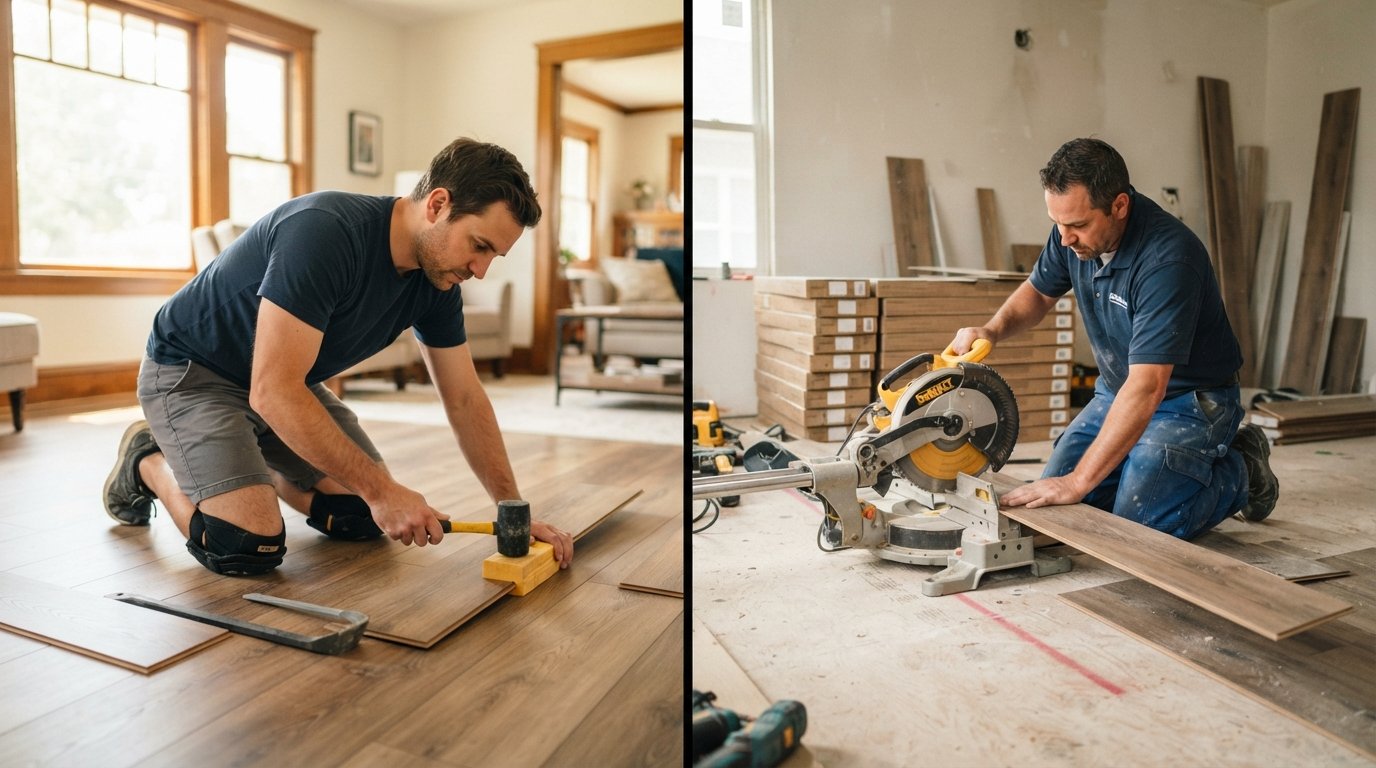
DIY Flooring Installation vs Professional Installer
Compare DIY flooring installation versus professional installer costs, skills, and risks to choose the best path for your home project.
By Adnan Nazir
Learn more about Floor Installation or Replacement for guides, costs, and what to expect.
Compare Floor Installation or Replacement Pros Near You

Enter your ZIP code to compare top-rated local professionals and request free quotes.
Your floors take a beating every single day. From muddy paw prints to dropped coffee mugs, they endure constant wear while setting the tone for your entire home. When those floors start looking tired, scratched, or hopelessly outdated, the question quickly shifts from whether to replace them to how to get the job done right. Should you roll up your sleeves for a weekend warrior project, or should you hand the tools to a seasoned professional? The answer is not always obvious, especially when you factor in hidden costs, time commitments, and the risk of costly mistakes.
Flooring is one of the few home improvements that touches nearly every room and dramatically affects both daily comfort and resale value. Installing it yourself can feel empowering, but it can also become a frustrating money pit if you lack the right tools or skills. Hiring a pro can feel expensive upfront, but the finished result is often flawless and backed by a warranty. This guide breaks down the real differences between DIY flooring installation versus professional installer services, helping you decide which path fits your budget, timeline, and tolerance for risk.
The Real Cost Equation: Materials, Tools, and Hidden Expenses
At first glance, DIY flooring installation looks like a clear winner for your wallet. You skip labor charges, which typically range from 40 to 70 percent of the total project cost. That savings can feel enormous, especially on a large job like 1,000 square feet of luxury vinyl plank or hardwood. However, the sticker price of materials is only the beginning of the story. DIYers often overlook the cost of specialized tools, wasted materials from cutting errors, and the value of their own time.
Professional installation quotes include labor, but they also bundle in the expertise that prevents expensive mistakes. A pro knows exactly how much material to order, accounting for cuts, waste, and future repairs. They arrive with truck-mounted equipment, moisture meters, and years of experience that prevent buckling, gaps, and squeaks. If you plan to sell your home within a few years, a professional installation with a warranty can be a selling point. For a deeper look at what labor and materials typically run, see our guide on average flooring installation cost.
To compare the true financial picture, list every expense you will incur. This includes the obvious and the easily forgotten.
- Materials: Flooring, underlayment, adhesive, transition strips, trim, and fasteners.
- Tool rental or purchase: Circular saw, jigsaw, tapping block, pull bar, spacers, knee pads, and a floor nailer or stapler for hardwood.
- Waste factor: Add 10 to 15 percent extra material for cuts and future repairs, more for complex layouts.
- Time investment: A 500-square-foot room might take a DIYer two to three weekends; a pro can finish in one or two days.
- Risk of rework: One bad row or a moisture issue can mean tearing out and starting over, doubling your material cost.
On the professional side, labor rates vary by region and material. Carpet tends to be the cheapest to install, while tile and hardwood sit at the higher end. But those labor dollars buy speed, precision, and accountability. Most installers also carry liability insurance and offer a workmanship warranty, meaning if something fails, they fix it. That peace of mind is hard to put a price on, but it is a real part of the value equation.
Skill, Tools, and the Learning Curve
Some flooring types are genuinely beginner-friendly, while others demand advanced skills that take years to master. Peel-and-stick vinyl and floating laminate planks are often marketed as DIY-friendly because they require minimal tools and no adhesive. But even these projects have pitfalls: uneven subfloors, incorrect expansion gaps, and poor acclimation can ruin the final result. Hardwood installation, especially nail-down or glue-down, requires precision, strength, and an understanding of how wood moves with humidity.
Tile installation is another category where DIY enthusiasm often meets reality. Cutting porcelain or ceramic tile requires a wet saw, and achieving a level, lippage-free surface demands patience and practice. Grouting and sealing add another layer of complexity. If you have never tiled before, a small backsplash might be a good starting point, but a large floor is a different beast. Professional installers bring not only skill but also the right tools for the job, which can cost hundreds or thousands of dollars to buy or rent.
Consider your own comfort level with the following tasks. If any of them make you nervous, a professional is likely the safer choice.
- Measuring and cutting accurately around door jambs, corners, and irregular shapes.
- Preparing the subfloor, including leveling, patching, and moisture testing.
- Handling heavy materials and operating power tools safely.
- Understanding manufacturer specifications for acclimation, expansion gaps, and underlayment.
Even if you are handy, the learning curve can be steep. A single mistake, such as a poorly leveled subfloor, can cause a floating floor to separate or a tile to crack. Professionals have seen these problems before and know how to avoid them. They also work efficiently because they repeat these tasks daily, which reduces the chance of fatigue-related errors.
Time, Convenience, and Lifestyle Factors
Time is money, but it is also a finite resource. A DIY flooring project can consume multiple weekends, evenings, and vacation days. If you work full-time or have a busy family schedule, the disruption can stretch for weeks. During that time, furniture is displaced, rooms are unusable, and dust and noise become constant companions. Professional installers typically complete a standard room in one to three days, allowing you to return to normal life much faster.
There is also the question of physical stamina. Flooring installation involves kneeling, bending, lifting, and repetitive motions. It can be tough on your back and knees. Professionals are accustomed to the physical demands and often work in teams to share the load. If you have health concerns or simply prefer not to spend your weekends on your hands and knees, hiring a pro is a reasonable investment in your well-being.
Convenience extends beyond the installation itself. Many professional flooring companies offer haul-away and disposal of old flooring, furniture moving, and even painting or trim work. They handle the logistics so you do not have to rent a dumpster or make multiple trips to the hardware store. For homeowners juggling work, family, and other responsibilities, that convenience can be worth every penny.
Quality, Durability, and Warranty Considerations
Quality is where the gap between DIY and professional installation often becomes most visible. A professionally installed floor lies flat, transitions smoothly, and stands up to daily wear without squeaks or gaps. Manufacturers often require professional installation to validate their product warranties. If you install it yourself and something goes wrong, you may find that the warranty is void, leaving you responsible for replacement costs.
Workmanship warranties are another key differentiator. A reputable installer will stand behind their labor for a specified period, often one to five years. If a plank buckles or a tile pops loose, they will return to fix it. When you DIY, you are the warranty. That is not necessarily a dealbreaker, but it is a risk to weigh carefully, especially for expensive materials like engineered hardwood or natural stone.
Durability also depends on proper subfloor preparation. Moisture issues, uneven concrete, or squeaky plywood can undermine even the best flooring. Professionals test for moisture, repair subfloor problems, and choose the right underlayment for your home. These steps are invisible in the finished product but critical to its longevity. Skipping them to save time or money often leads to premature failure, which means paying twice for the same project.
When DIY Makes Sense and When It Does Not
DIY flooring installation can be a rewarding experience for the right person and the right project. If you are installing a floating floor in a small room, have some basic carpentry skills, and can dedicate a few weekends, you might save thousands of dollars. It is also a good option if you are handy, have a helper, and are willing to invest in or rent the necessary tools. The key is to be honest about your abilities and the complexity of the job.
On the other hand, certain situations call for a professional. If you are installing tile, hardwood, or any material that requires precise cuts and subfloor preparation, the risk of a poor outcome rises sharply. Large rooms, complex layouts, stairs, and multiple rooms also increase the difficulty. If your subfloor is uneven or has moisture issues, a pro can diagnose and fix those problems before they ruin your new floor. And if you simply do not have the time or physical capacity, hiring a professional is the practical choice.
For homeowners who want to explore both options, getting free quotes is a smart first step. You can compare the cost of professional installation against your DIY budget and decide if the savings justify the effort. Platforms like Repairmen connect you with vetted local pros for a range of home services, including flooring, so you can see exactly what a professional would charge before committing to a DIY approach.
How to Decide: A Practical Framework
To make the best choice, evaluate your project against four key factors: budget, skill, time, and risk tolerance. Start by getting at least three professional quotes. This gives you a baseline for the labor cost and helps you understand what the job entails. Then, honestly assess your own abilities. Have you installed flooring before? Do you own the tools? Can you afford to redo the project if something goes wrong?
Next, consider the material. Some products, like luxury vinyl plank, are designed for DIY installation and forgiving of minor mistakes. Others, like natural stone tile, are unforgiving and best left to experts. If you are unsure, talk to a flooring specialist at a local store or read the manufacturer's installation guidelines. They often specify whether the product is suitable for DIY or recommends professional installation.
Finally, think about your long-term plans. If you are flipping a house or plan to sell soon, a professional installation adds credibility and may attract buyers. If you are staying in your home for decades, the durability and warranty of a pro installation can provide lasting value. Either way, the goal is a beautiful, functional floor that enhances your home. Whether you choose DIY flooring installation versus professional installer services, the right decision is the one that balances your resources with your expectations.
Take the time to gather quotes, evaluate your skills, and weigh the true costs. A little upfront research can save you from a costly learning experience and ensure your new floors look great for years to come.
Learn more about Floor Installation or Replacement for guides, costs, and what to expect.
Compare Floor Installation or Replacement Pros Near You
Enter your ZIP code to compare top-rated local professionals and request free quotes.