
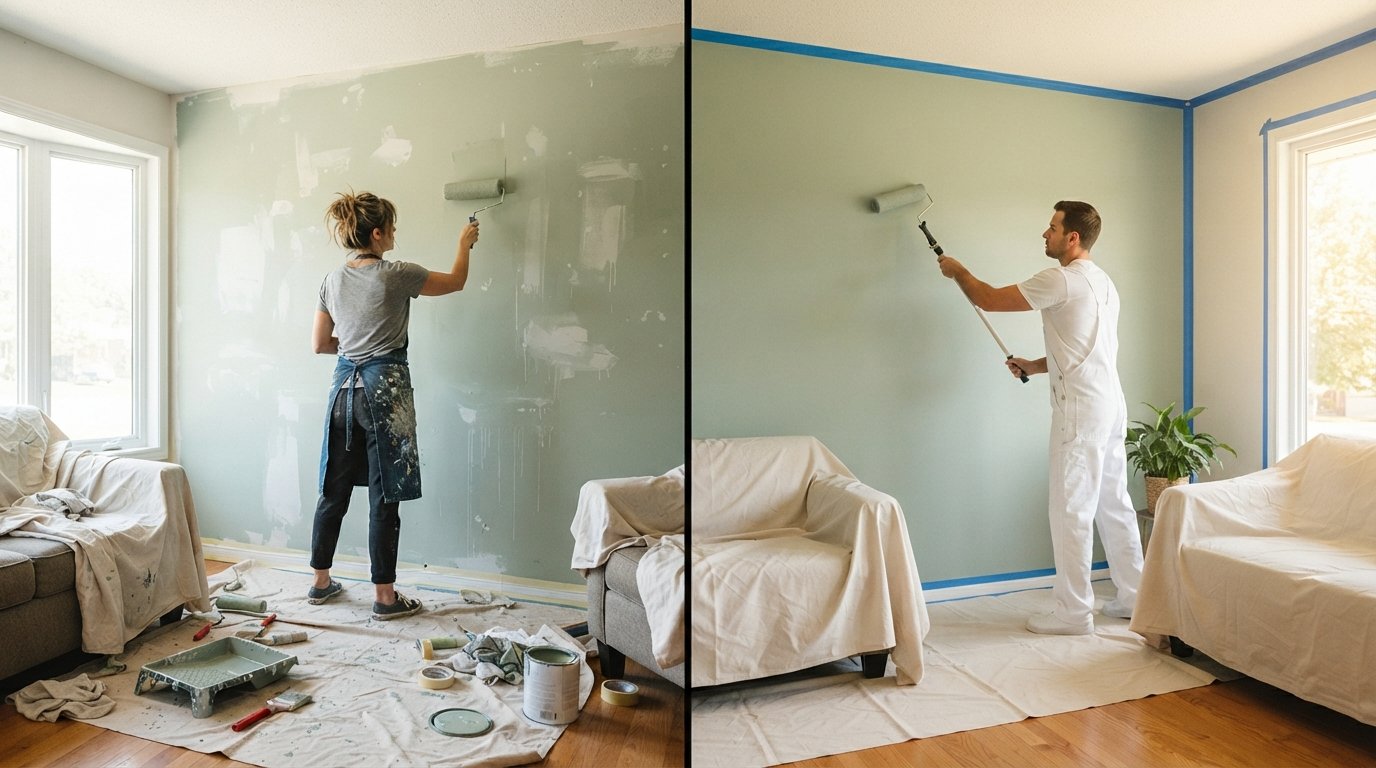
DIY Painting Versus Hiring a Professional Painter
DIY painting versus hiring a professional painter comes down to time, skill, and risk. Compare real costs and choose the right option for your home.

By Elena John
Learn more about Interior Painting for guides, costs, and what to expect.
Compare Interior Painting Pros Near You

Enter your ZIP code to compare top-rated local professionals and request free quotes.
Your living room walls are looking tired, the trim has seen better days, and you have a free weekend coming up. The question that follows is one nearly every homeowner faces at some point: should you grab a roller and tackle the job yourself, or should you write a check and let a professional handle it? The answer is not as obvious as it might seem. A gallon of paint costs far less than a contractor's labor, but the true cost of a DIY paint job includes your time, your tools, the risk of uneven finishes, and the possibility that you will have to pay someone to fix mistakes later. Understanding where DIY painting makes sense and where hiring a professional painter pays off is the key to protecting both your budget and your home's appearance.
The Real Cost Breakdown: DIY Painting Versus Hiring a Professional Painter
When homeowners compare DIY painting versus hiring a professional painter, the first number they look at is usually the paint itself. A gallon of mid-grade interior paint runs between $25 and $50, and a typical bedroom might need two or three gallons for two coats. Add primer, tape, drop cloths, rollers, brushes, and trays, and you are looking at roughly $150 to $300 in materials for a single room. That sounds like a bargain compared to a professional painter's quote, which might range from $400 to $900 for the same space depending on your region and the condition of the walls.
But the sticker price of materials is only part of the equation. Your time has value, and a professional painter can complete a room in a single day while a first-time DIYer might spend an entire weekend prepping, painting, and cleaning up. If you earn $30 per hour and spend 16 hours on the project, you have effectively added $480 in labor to your DIY cost. Suddenly the gap between DIY and professional painting narrows considerably.
There are also hidden costs that catch DIYers off guard. Quality brushes, rollers, and extension poles add up quickly. Ladder rentals for high ceilings, plastic sheeting for furniture protection, and specialized tools for cutting in around windows and doors can push your material budget past $400 for a multi-room project. And if the finish looks uneven or you miss spots, you will need to buy more paint and spend more time on touch-ups. Professional painters factor all of these costs into their quotes, which means the price you see is the price you pay.
For homeowners who want a clearer picture of what local painters charge in their area, requesting free quotes from multiple contractors is the fastest way to benchmark pricing. A platform like FreeQuotes.Contractors connects you with pre-vetted painting professionals who provide competitive bids, so you can compare real numbers instead of guessing.
Time, Skill, and the Quality Gap
Painting looks simple from a distance. You dip a roller, roll it on the wall, and wait for it to dry. In practice, achieving a smooth, professional finish requires technique that takes years to master. Cutting in along ceilings and baseboards without tape, maintaining a wet edge to avoid lap marks, and applying consistent pressure to prevent roller streaks are skills that separate a satisfactory paint job from one that looks flawless.
Professional painters also bring preparation expertise that most homeowners underestimate. Proper prep work includes filling nail holes, sanding rough patches, caulking gaps around trim, and priming stains or bare drywall. Skipping these steps leads to peeling, flashing, and uneven sheen. A professional will spend as much time prepping as painting, and that preparation is what makes the final result last for years.
Skill matters even more when the job involves challenging surfaces or heights. Painting vaulted ceilings, stairwells, or exterior siding requires ladders, scaffolding, and safety equipment that most homeowners do not own. Professional painters carry insurance that covers accidents and damage, which protects you from liability if someone gets hurt on your property. That coverage is worth far more than the savings from a DIY approach.
If you want to learn how to evaluate a painter's qualifications before you hire, your guide to hiring a professional wall painting contractor walks through the questions to ask, the licenses to verify, and the red flags to avoid.
When DIY Painting Makes Sense
DIY painting is not always the wrong choice. For small, low-risk projects, doing it yourself can save money and give you a sense of accomplishment. A single accent wall, a powder room, or a piece of furniture are all manageable projects for a motivated beginner. These jobs require minimal prep, few tools, and can be completed in a few hours without specialized equipment.
DIY painting also makes sense when you are testing colors or experimenting with a temporary look. If you are unsure whether a deep green will work in your dining room, painting a sample board or one wall yourself lets you live with the color before committing to a full professional job. This approach saves money on consultation and gives you flexibility to change your mind.
Another scenario where DIY works well is when you have prior painting experience and the right tools already. If you have painted rooms before and own quality brushes, rollers, and drop cloths, the marginal cost of another DIY project is low. You know how to cut in, you understand dry times, and you can troubleshoot common problems like drips and uneven coverage. In that case, the savings from DIY are real and substantial.
Here are the situations where DIY painting is typically a smart choice:
- Small rooms or accent walls with minimal prep work
- Furniture, cabinets, or decorative items that do not require perfect finishes
- Rental properties where you are comfortable with a good-enough result
- Color testing before committing to a full repaint
- Projects where you already own the necessary tools and have prior experience
Outside of these scenarios, the risks of DIY painting start to outweigh the savings. Large rooms, high ceilings, exterior surfaces, and rooms with extensive prep needs are all better left to professionals who can deliver a durable, consistent finish.
When Hiring a Professional Painter Is the Better Investment
Professional painting becomes the smarter financial decision as the complexity and visibility of the project increase. A professional painter brings speed, consistency, and a warranty that DIY work cannot match. If a professional job peels or fades prematurely, you have recourse. If your DIY job fails, you absorb the cost of redoing it.
Exterior painting is a prime example. Weather exposure, surface preparation, and the need for specialized coatings make exterior projects far more demanding than interior work. Professionals know which primers to use on different substrates, how to treat mildew and rot, and how to apply paint in the right temperature and humidity conditions. A failed exterior paint job can lead to wood rot, water intrusion, and costly repairs that dwarf the original painting budget.
Hiring a professional also makes sense when your time is limited or your health restricts physical activity. Climbing ladders, crouching to paint baseboards, and breathing paint fumes are not advisable for everyone. Professional painters handle these challenges safely and efficiently, completing in days what might take you weeks of evenings and weekends.
Another advantage of hiring a pro is access to premium materials. Many professional painters have trade accounts that give them access to higher-quality paints and primers at discounted prices. These products often last longer and cover better than the consumer-grade options available at big-box stores. When you factor in the durability and appearance of the finished job, the professional's material advantage can justify a significant portion of their labor cost.
How to Compare DIY Costs and Professional Quotes
To make a truly informed decision, you need to compare apples to apples. Start by estimating your DIY costs in detail, including materials, tools you do not already own, and the value of your time. Then request quotes from at least three professional painters in your area. The quotes should itemize labor, materials, prep work, and any special requirements like high ceilings or exterior surfaces.
When comparing quotes, look beyond the bottom line. A low quote that excludes prep work or uses cheap paint may cost you more in the long run. A high quote that includes thorough prep, premium materials, and a written warranty may be the better value. Ask each painter what is included and what would trigger additional charges.
For homeowners who want to streamline the comparison process, FreeQuotes.Contractors offers a free quote request system that matches you with local painting professionals. You can submit your project details once and receive multiple competitive bids, saving hours of phone calls and research. The platform also provides educational resources on painting costs and contractor selection, so you can evaluate quotes with confidence.
If your project expands beyond painting into other repairs or renovations, you may need a broader network of service professionals. Repairmen is a nationwide platform that connects homeowners with vetted local pros for appliance repair, remodeling, maintenance, and emergency services, which can be useful if your painting project uncovers underlying issues like water damage or faulty wiring.
Making the Final Call: DIY Painting Versus Hiring a Professional Painter
The decision between DIY painting and hiring a professional painter comes down to three factors: the size and complexity of the job, your available time and skill level, and your tolerance for risk. Small, simple projects in good condition are ideal for DIY. Large, complex, or high-visibility projects are almost always better handled by a professional.
Consider the long-term cost of a poor paint job. Peeling paint, uneven coverage, and sloppy edges detract from your home's value and may require professional correction later. When you weigh the potential savings of DIY against the risk of a failed project, the professional option often looks more affordable than it first appears.
Ultimately, the best approach is to gather information before you decide. Get quotes, estimate your own costs honestly, and be realistic about your skills and schedule. Whether you choose to paint it yourself or hire a pro, the goal is the same: a beautiful, durable finish that enhances your home and protects your investment.