
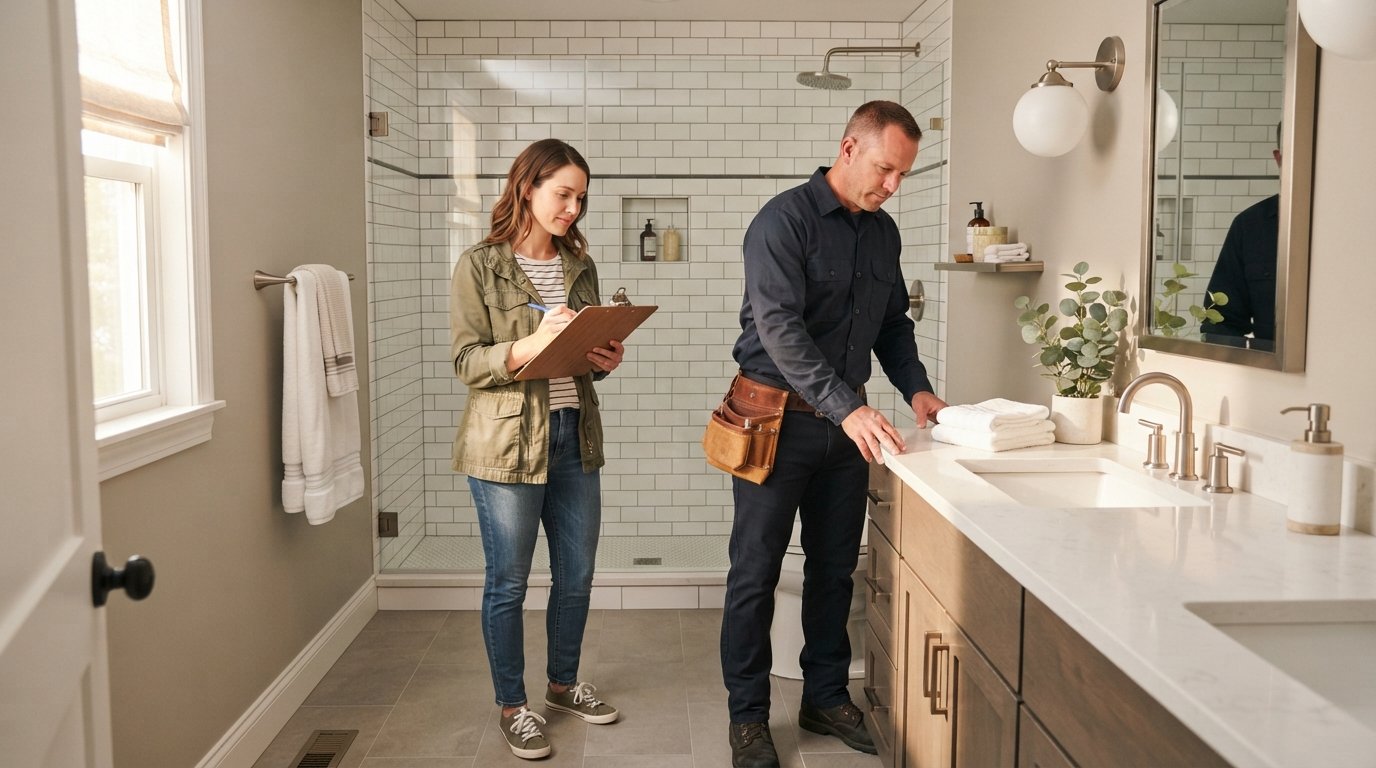
Bathroom Remodel ROI: Which Upgrades Add Value in 2026
Bathroom remodel ROI depends on the upgrades you choose. Call 8332111668 to compare local contractor quotes and protect your return.

By Elena John
Learn more about Bathroom Remodel for guides, costs, and what to expect.
Compare Bathroom Remodel Pros Near You

Enter your ZIP code to compare top-rated local professionals and request free quotes.
Every homeowner who has stared at a dated bathroom has asked the same question: will this project actually pay me back? The answer is not a simple yes or no. Bathroom remodel ROI depends heavily on which upgrades you choose, how much you spend, and how well your finished space matches what buyers in your market expect. Nationally, midrange bathroom remodels recover roughly 60 to 70 percent of their cost at resale, while upscale projects often return closer to 50 percent. That gap tells you something important: the goal is not to build the most luxurious bathroom on the block. It is to spend wisely on the features that buyers genuinely value.
This guide breaks down which upgrades deliver the strongest bathroom remodel ROI, which ones you should treat as personal enjoyment rather than investment, and how to plan a project that balances your budget with long-term value. Whether you are preparing to sell or simply want a better bathroom for the years ahead, understanding the numbers helps you make confident decisions instead of guessing.
Why Bathroom Remodel ROI Varies So Much
Two identical bathrooms in two different neighborhoods can produce very different returns. Location, home price tier, and buyer expectations all shape how much of your investment comes back. In a market where comparable homes have updated bathrooms, a renovated space helps your home compete and can prevent price cuts. In a neighborhood where most bathrooms are original, a modest refresh may be all you need to stand out.
The scope of your project matters just as much. A cosmetic refresh that replaces fixtures, paint, and lighting costs far less than a full gut renovation that moves plumbing and reconfigures the layout. The smaller project usually recovers a higher percentage of its cost because you are not paying for structural changes that buyers rarely notice. Meanwhile, high-end materials like imported stone and custom cabinetry can push your budget into territory that resale values simply do not support.
Timing also plays a role. If you plan to sell within a year or two, prioritize upgrades with broad appeal and proven returns. If this is your forever home, you can justify choices that make you happy even if they do not fully pay back, as long as you understand that trade-off going in.
The Upgrades That Consistently Add Value
Certain improvements show up again and again in ROI studies because they solve real problems for real buyers. These upgrades modernize the space, improve function, and avoid the extremes that narrow your pool of interested buyers.
Here are the upgrades that typically deliver the best bathroom remodel ROI:
- Vanity and storage updates: A new vanity with solid drawers and a clean countertop transforms the most-used area of the bathroom. Buyers notice storage immediately.
- Modern lighting: Layered lighting (vanity lights, recessed ceiling lights, and a dimmer) makes the room feel larger, brighter, and more current.
- Low-flow fixtures: Water-saving toilets, faucets, and showerheads appeal to efficiency-minded buyers and often qualify for utility rebates.
- Fresh tile in high-impact areas: New floor tile and a tiled shower surround deliver a dramatic visual upgrade without moving any plumbing.
- Quality ventilation: A quiet, properly sized exhaust fan prevents moisture damage and mold, a detail that reassures buyers and inspectors.
Notice that none of these require relocating walls or rerouting drains. Keeping plumbing in place is one of the simplest ways to protect your return, because labor for layout changes is expensive and rarely recovered at sale. If your current layout works, improve it rather than reinvent it.
Moisture protection deserves special attention here, because water damage is the silent killer of bathroom value. Even a beautiful renovation will fail inspection or scare off buyers if the shower leaks behind the walls. If your project involves a new shower or tub surround, take time to understand proper waterproofing methods. Our guide on bathroom remodel waterproofing techniques that last explains how to protect your investment from the inside out.
Upgrades With Weaker Returns
Some features feel luxurious in the showroom but struggle to pay you back. Steam showers, whirlpool tubs, heated floors, and elaborate built-in sound systems can consume a large share of your budget while appealing only to a narrow slice of buyers. In many markets, a soaking tub that rarely gets used takes up square footage that a larger shower could use more profitably.
That does not mean you should never install them. If a heated floor makes your winter mornings bearable, that comfort has real value to you. The key is honesty about the category. Treat premium extras as lifestyle spending, not as investments, and make sure they fit within a budget you can afford without straining other priorities. A common mistake is blowing most of the budget on one dramatic feature and then cutting corners on the fundamentals, like waterproofing, ventilation, and quality hardware. Buyers and inspectors notice those corners.
Budget Allocation: Where the Money Should Go
A smart bathroom budget follows a rough hierarchy. Spend first on the elements that are expensive to redo later (plumbing, waterproofing, electrical, and ventilation), then on the surfaces people see and touch every day (vanity, tile, fixtures), and last on decorative extras.
As a practical framework, many successful midrange remodels break down like this:
- Labor and installation: often 40 to 50 percent of the total, and the hardest cost to reduce without risking quality.
- Cabinetry and countertops: typically 15 to 20 percent, with strong visual impact.
- Fixtures and fittings: about 10 to 15 percent for the toilet, sink, faucet, and shower components.
- Tile and flooring: roughly 10 to 15 percent, depending on material choices.
- Lighting, paint, and contingency: the remainder, plus a reserve of 10 to 20 percent for surprises behind the walls.
That contingency line is not optional. Older homes frequently hide rotted subflooring, outdated wiring, or slow leaks once demolition begins. Homeowners who skip the reserve often end up making panicked compromises mid-project, which is exactly when costly mistakes happen.
How to Estimate Your Bathroom Remodel ROI Before You Start
You can estimate your return before spending a dollar by working backward from your home's value. Find recent sales of similar homes in your area with updated bathrooms and compare them to homes with original bathrooms. The price difference gives you a rough ceiling for what buyers will pay for a renovated bath in your neighborhood. If that difference is 15,000 dollars, spending 40,000 dollars on an upscale remodel will not make financial sense unless you plan to stay for many years.
Next, gather real numbers instead of relying on national averages. Costs vary widely by region, labor availability, and material selection. The most reliable approach is to collect competitive bids from local professionals who can assess your specific space. Platforms like USremodel connect homeowners with independent contractors for remodeling and repair projects, which makes it easier to compare real quotes rather than guess at budgets. When you request multiple estimates for the same scope of work, you get a clear picture of fair market pricing in your area and a stronger negotiating position.
Once you have bids in hand, calculate your expected ROI with a simple formula: divide the projected increase in home value by your total project cost, then multiply by 100. If a 20,000 dollar remodel adds 14,000 dollars in value, your return is 70 percent. Run this calculation for a modest refresh and a full renovation separately, then choose the scope that matches both your goals and your timeline.
Planning the Project Without Overpaying
Even a well-chosen upgrade list can go sideways without a solid process. Start by defining your must-haves versus nice-to-haves in writing, and share that list with every contractor you contact so bids compare apples to apples. Ask each bidder to itemize labor and materials separately, and question any quote that arrives as a single lump sum with no detail.
Verify licensing, insurance, and references before signing anything, and insist on a written contract that covers the payment schedule, timeline, change-order process, and warranty terms. A modest deposit with payments tied to completed milestones protects you far better than a large upfront check. If you want a structured way to evaluate the professionals competing for your project, learning how to compare contractor estimates side by side will help you spot hidden costs, negotiate better deals, and choose the right pro with confidence.
Finally, keep resale in mind even if you are not selling soon. Neutral colors, timeless tile shapes, and quality craftsmanship age well, while trend-driven choices can date quickly. A bathroom that feels clean, bright, and functional will hold its value through changing design fashions, which is ultimately what strong bathroom remodel ROI is all about.
Focus your spending on the upgrades buyers reward, protect the project with proper waterproofing and a realistic contingency, and collect competitive local quotes before committing. Do those three things, and your bathroom will serve you well today while returning meaningful value when you eventually sell.