
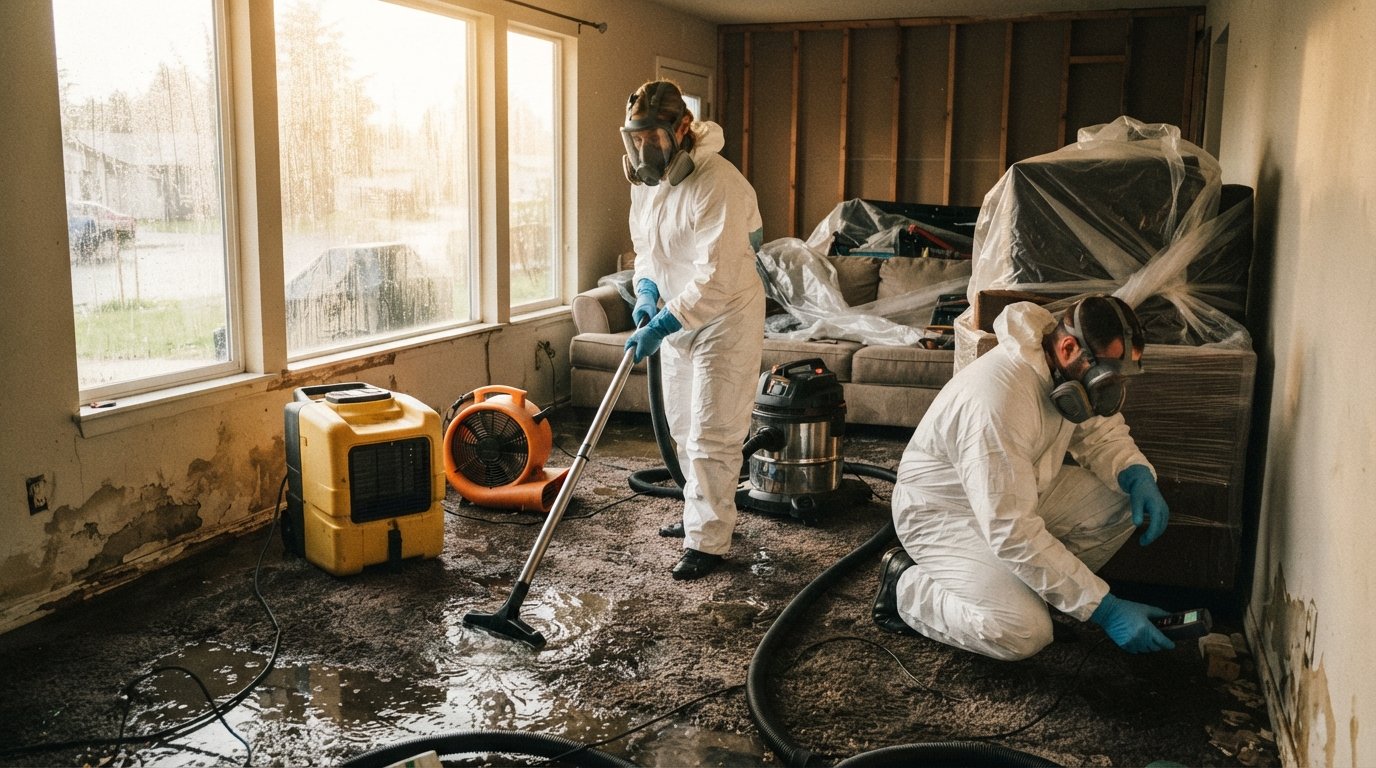
How to Choose an Emergency Restoration Contractor After a Flood
Learn how to choose an emergency restoration contractor after a flood and protect your claim and your home. Call (833)-211-1668 for vetted local pros and free quotes.

By Julian Ellis
Learn more about Water Damage Cleanup and Restoration for guides, costs, and what to expect.
Compare Water Damage Cleanup and Restoration Pros Near You

Enter your ZIP code to compare top-rated local professionals and request free quotes.
Floodwater does not wait, and neither should you. Within minutes, water wicks into drywall, seeps under flooring, and begins feeding the mold spores that are already present in nearly every home. The contractor you call in the first few hours will determine whether your house dries out safely or becomes a long, expensive insurance battle. Choosing the right emergency restoration contractor after a flood is one of the highest-stakes hiring decisions a homeowner can make, and it is almost always made under pressure. This guide walks you through the exact criteria, red flags, and billing questions that separate legitimate restoration professionals from storm chasers who appear after every major weather event.
Why the First 48 Hours Decide Everything
Mold can begin colonizing wet building materials in as little as 24 to 48 hours. That timeline is not a marketing scare tactic; it is standard guidance from restoration and indoor air quality professionals. Category 1 water (clean supply-line water) becomes Category 2 (gray water) within about 48 hours as bacteria multiply, and Category 2 water degrades into Category 3 (black water) if it sits longer. Once contaminated water soaks into porous materials like carpet, insulation, and particleboard, those materials usually cannot be saved.
This is why the restoration industry has a term for the ideal response window: drying must begin, not just be scheduled, within 24 to 48 hours. A legitimate emergency restoration contractor will answer the phone at night, dispatch a crew quickly, and start extraction and drying equipment on day one. A storm chaser will promise everything, collect a large deposit, and disappear or subcontract the work to whoever is available.
Your job in those first hours is not to become a restoration expert. It is to ask the right questions fast, verify the answers, and sign only what protects you. The checklist below covers the credentials that actually matter.
Credentials and Certifications That Actually Matter
Anyone can print "water damage specialist" on a truck. What you want are verifiable, third-party credentials issued by recognized bodies. The gold standard in the United States is the Institute of Inspection, Cleaning and Restoration Certification (IICRC), which certifies firms and technicians in water damage restoration (WRT), applied structural drying (ASD), and mold remediation. Ask for the certification number and confirm it on the IICRC website while the crew is still in your driveway.
Beyond certification, verify the legal and insurance basics. A contractor doing flood restoration should carry general liability insurance and workers compensation, hold a state or local license where required, and be able to produce a certificate of insurance on request. Do not accept a verbal assurance; ask the office to email the certificate directly from the insurer. If a company cannot produce proof of insurance within an hour, that is a reason to keep calling.
Here is a short list of credentials and documents to verify before you allow anyone to begin work:
- IICRC firm certification and individual technician certifications (WRT, ASD, mold remediation).
- State or local contractor license number, checkable through your licensing board.
- Certificate of insurance for general liability and workers compensation, sent from the insurer.
- Written scope of work and drying plan, not just a verbal estimate.
- A physical local address and references from nearby jobs you can actually call.
One more credential matters after a declared disaster: registration with your state's consumer protection or contractor licensing agency, and sometimes FEMA qualification if you plan to seek federal assistance. Legitimate firms will happily provide these details. Storm chasers will get defensive or claim the paperwork is "in the truck."
Red Flags of Storm-Chasing Restoration Companies
After every major flood, out-of-state crews descend on affected neighborhoods. Some are excellent; many are not. The pattern is predictable. They arrive in unmarked vans or trucks with out-of-state plates, knock on doors offering "free inspections," and pressure homeowners to sign authorization forms on the spot. They demand large cash deposits or full payment upfront, promise to "handle everything with your insurance," and vanish once the check clears, leaving incomplete drying and no one to call.
Watch for these specific warning signs during your first conversation:
- High-pressure tactics: "We can only hold this price for the next hour" or "Your house will be condemned if you wait."
- Requests for large upfront cash payments or payment before any work begins.
- No local address, no verifiable license, or refusal to provide insurance certificates.
- Offers to "waive your deductible" or inflate the claim, which is insurance fraud.
- Door-to-door solicitation combined with a demand to sign an assignment of benefits (AOB) on the spot.
The assignment of benefits form deserves special attention. Signing an AOB transfers your insurance rights to the contractor, who then bills your insurer directly. While legal in some states, AOBs are a well-documented source of disputes, inflated claims, and liens on homes. Never sign one at the door. Ask for time to review it, and check with your insurer first.
By contrast, a trustworthy emergency restoration contractor will encourage you to call your insurance company, provide documentation, and read everything before signing. They will also welcome comparison shopping. In fact, comparing written scopes and pricing before committing is one of the strongest protections you have, and our guide on fixed price vs variable contract explains how contract structure affects your final bill.
How Restoration Billing and Insurance Coordination Should Work
Water damage restoration is billed in a way that surprises most homeowners. Reputable firms use standardized estimating software, typically Xactimate, which is also used by most insurers. That means the contractor's estimate and your adjuster's estimate are built from the same line-item pricing, which dramatically reduces disputes. Ask any candidate whether they estimate in Xactimate and whether they will provide a line-item scope. If the answer is a lump-sum number written on a business card, keep looking.
The financial flow should follow a clear sequence. You file a claim, the adjuster inspects, the contractor provides a detailed scope, and work begins with the insurer's approval or your written authorization. Many policies cover emergency mitigation (extraction, drying, mold prevention) even before the full claim is settled, because mitigation prevents further damage. A good contractor knows this and will document everything with moisture readings, photos, and daily logs so your claim is supported.
Ask these billing questions before anyone starts work:
- Will you provide a line-item estimate in Xactimate or a comparable format?
- Do you bill my insurer directly, and what do you need from me to do that?
- What is your policy on deposits, and will payments be tied to completed milestones?
- How do you document moisture readings and drying progress for the claim file?
- Will you provide a certificate of satisfaction and lien waiver when the job is done?
A contractor who answers these clearly is coordinating with your insurer, not working against you. If you are still gathering bids, you can request free, no-obligation quotes from pre-vetted local contractors through Contractor.Homes and compare scopes side by side before the clock runs out.
Mold Prevention Steps That Must Start Within 48 Hours
Even the best contractor cannot reverse mold growth that was allowed to start. Your own actions in the first two days matter as much as the crew you hire. The goal is to remove standing water, get air moving, and dry structural cavities before spores can colonize. If you are waiting for an adjuster or a contractor to arrive, begin safe mitigation yourself.
Focus on these steps immediately:
- Stop the water source if it is safe to do so, and shut off electricity to flooded areas.
- Remove standing water with a wet/dry vacuum or pump, and move furniture and rugs off wet floors.
- Pull up wet carpet and padding, which are almost always unsalvageable after a flood.
- Run fans and a dehumidifier, and open windows only if outdoor humidity is lower than indoor humidity.
- Photograph everything before disposal, and keep receipts for any equipment you rent.
Do not use ordinary box fans in a Category 3 (contaminated) flood; they can spread bacteria and mold spores through the house. Professional restoration crews use air scrubbers with HEPA filtration and negative air pressure to contain contamination. This is one concrete reason to hire a certified firm quickly rather than improvising with household equipment for days.
A Practical Vetting Framework for a Panicked Moment
When you are standing in a flooded hallway, you do not have time for a long interview. Use a simple three-call framework. Call three restoration companies, ask each the same five questions, and compare the answers. The five questions are: Are you IICRC certified, and what is your certification number? Can you email your certificate of insurance right now? Will you provide a line-item Xactimate estimate? What is your deposit and payment schedule? How soon can a crew be on site, and who is the on-site supervisor I can call directly?
Score the answers. A company that answers all five confidently, sends documentation promptly, and offers a written scope is a serious candidate. A company that dodges even one question, especially about insurance or certification, should be eliminated. After the emergency phase, you can slow down and compare full proposals; our marketplace makes that easy with free quote requests and local, pre-vetted professionals.
Finally, document everything. Keep a folder with the signed authorization, the scope of work, daily moisture logs, photos, and all invoices. If a dispute arises, that folder is your leverage. A reputable contractor will not mind; they will appreciate a homeowner who keeps clean records.
Choosing an emergency restoration contractor after a flood comes down to verification under pressure: confirm certifications, reject high-pressure tactics, insist on line-item billing that works with your insurer, and start mold prevention within 48 hours. Do those four things, and you will protect both your home and your claim.