
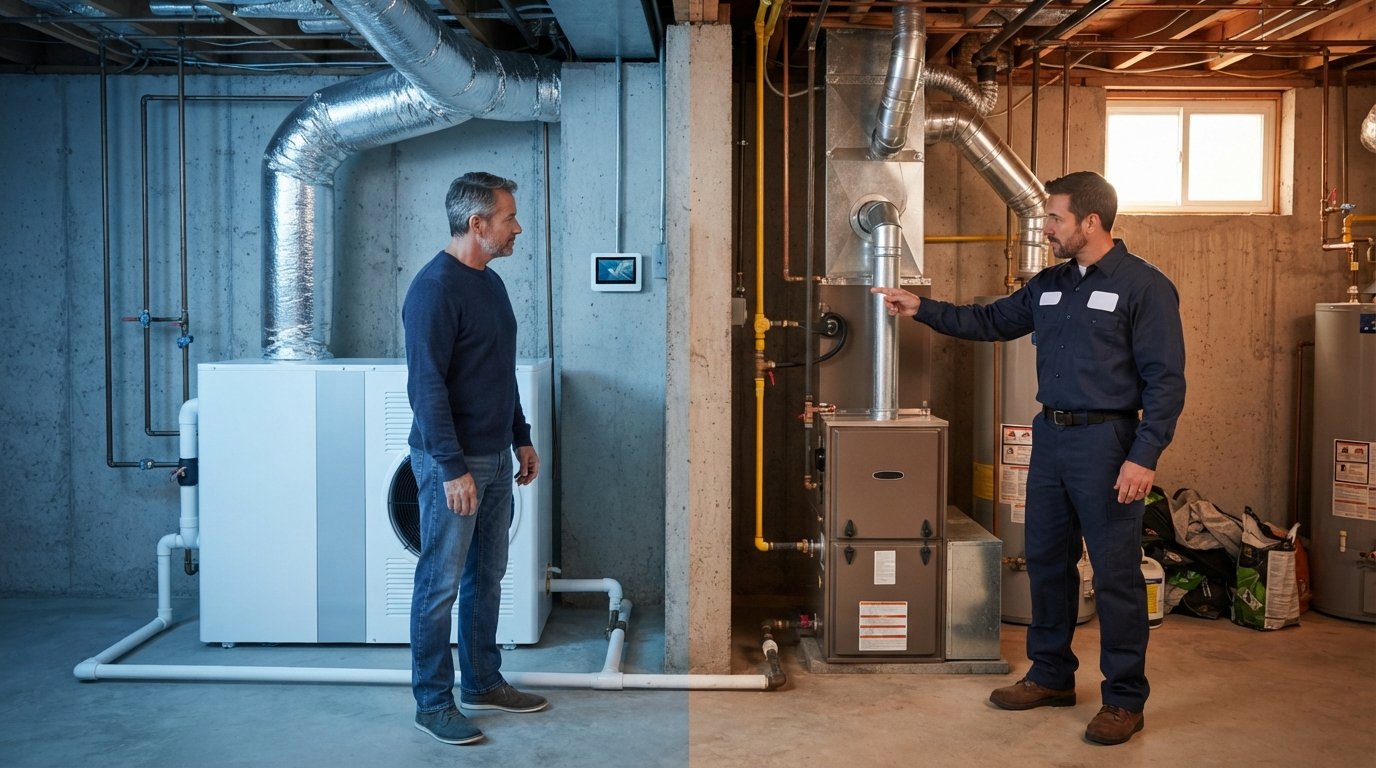
Heat Pump vs Furnace: Cost and Efficiency Comparison
Compare heat pump vs furnace cost and efficiency with real numbers, incentives, and regional savings. Call (833)-211-1668 for help finding local HVAC quotes.

By Julian Ellis
Learn more about Heating System Installation or Replacement for guides, costs, and what to expect.
Compare Heating System Installation or Replacement Pros Near You

Enter your ZIP code to compare top-rated local professionals and request free quotes.
Replacing a heating system is one of the most consequential financial decisions a homeowner can make. The choice between a heat pump and a furnace affects upfront costs, monthly utility bills, comfort during extreme cold, and even the resale value of your home. Yet the decision is rarely as simple as comparing sticker prices. A furnace might cost less to install but drive up winter energy bills in mild climates. A heat pump might deliver impressive efficiency but require a costly electrical upgrade in an older home. This heat pump vs furnace cost and efficiency comparison cuts through the marketing claims and gives you a practical framework for choosing the right system for your climate, your budget, and your long-term plans.
The stakes are high. Heating and cooling account for more than half of a typical home's energy use, according to the U.S. Department of Energy. Choosing the wrong system can lock you into decades of higher operating costs or leave you shivering during a cold snap. The good news is that modern heat pumps have closed much of the cold-weather performance gap that once made furnaces the default choice in northern states. Federal and local incentives have also reshaped the math, sometimes making heat pumps the cheaper option even before energy savings are counted. What follows is a clear-eyed look at installed costs, efficiency ratings, regional operating costs, and the load assessment calculations that should drive your final decision.
Installed Cost Comparison: What You Actually Pay
When homeowners compare heat pump vs furnace cost, the first number they encounter is usually the equipment price. That number is misleading. The installed cost, which includes labor, ductwork modifications, electrical work, and permitting, is what actually comes out of your bank account. A standard gas furnace typically ranges from $3,000 to $7,000 installed, depending on efficiency rating and home size. A central heat pump generally runs $5,500 to $12,000 installed, with cold-climate models and ducted retrofits pushing toward the higher end. Ductless mini-split heat pumps, which avoid ductwork entirely, can range from $3,000 to $10,000 for a multi-zone setup.
The gap narrows considerably once incentives are factored in. The federal Inflation Reduction Act introduced a tax credit covering 30% of heat pump installation costs, up to $2,000 annually, and many states and utilities layer rebates on top. In some markets, total incentives exceed $5,000, bringing the net installed cost of a heat pump close to or below that of a furnace. The catch is that incentives vary widely by ZIP code and income level, and some require using a qualified contractor. A furnace replacement, by contrast, rarely qualifies for meaningful federal incentives unless you are upgrading to a high-efficiency condensing model.
There is another cost dimension that homeowners frequently overlook: infrastructure. Heat pumps move heat rather than generate it, so they run on electricity. Homes with older electrical panels, insufficient service amperage, or no central return ducts may need upgrades before a heat pump can be installed. These upgrades can add $1,500 to $4,000 to the project. Furnaces, particularly gas models, may require venting modifications but generally place fewer demands on the electrical system. Before committing to either option, it is worth understanding how contractors structure their bids and where hidden costs tend to appear, which is why our guide on basement to ADU conversion cost and contractor planning offers useful parallels for evaluating complex renovation bids.
Efficiency Ratings Explained: HSPF, AFUE, and What They Mean
Efficiency is where the heat pump vs furnace comparison becomes genuinely interesting. Furnaces are rated by AFUE, or Annual Fuel Utilization Efficiency. A standard furnace might rate 80% AFUE, meaning 80 cents of every dollar of fuel becomes heat and the rest escapes through the flue. A high-efficiency condensing furnace can reach 96% to 98% AFUE. That sounds impressive until you compare it to heat pumps, which are rated by HSPF2, or Heating Seasonal Performance Factor. Because heat pumps move existing heat rather than burning fuel, they routinely achieve effective efficiencies of 200% to 300% or more. In practical terms, a heat pump can deliver three units of heat for every unit of electricity it consumes.
This efficiency advantage translates directly into operating cost savings, but the magnitude depends on local energy prices. In regions where electricity is expensive and natural gas is cheap, a high-efficiency furnace can still win on monthly costs. In regions with moderate electricity rates or where homeowners are switching from propane or oil, heat pumps typically deliver substantial savings. The efficiency comparison also extends to cooling. A heat pump provides air conditioning in summer, whereas a furnace does not. Homeowners who currently rely on a separate central air conditioner must factor that equipment into the furnace side of the comparison, which often closes the cost gap entirely.
Modern cold-climate heat pumps have narrowed the performance gap further. Models rated for operation at 5 degrees Fahrenheit and below now use vapor injection and variable-speed compressors to maintain capacity in freezing weather. In many climates, a cold-climate heat pump can handle the entire heating load without backup. In harsher climates, a dual-fuel setup pairing a heat pump with a gas furnace as backup offers the best of both worlds: efficient heat pump operation for most of the year and furnace reliability during extreme cold.
Regional Operating Costs: Where Each System Wins
Operating cost estimates are where the heat pump vs furnace cost and efficiency comparison becomes highly location-specific. The U.S. Department of Energy publishes heating cost comparisons by climate zone, and the results vary dramatically. In mild climates like the Southeast and Pacific Northwest, heat pumps almost always operate more cheaply than furnaces because heating loads are modest and cooling demand is high. In the Midwest and Northeast, where winters are long and natural gas is inexpensive, a high-efficiency furnace may still have a lower annual operating cost unless electricity prices are low or the homeowner is switching from propane or oil.
Homeowners heating with propane or oil face the starkest math. Propane and heating oil cost far more per unit of delivered heat than natural gas or electricity in most markets, and heat pumps routinely cut those costs by 40% to 60%. For a homeowner spending $3,000 per winter on propane, a heat pump that reduces that to $1,500 pays back its installation premium in just a few years. Natural gas is a different story: in states with low gas rates, the operating savings from a heat pump may be modest or even negative, though the cooling and environmental benefits still factor into the decision.
To estimate operating costs accurately, homeowners need three numbers: the system's efficiency rating, the local cost per unit of fuel or electricity, and the estimated annual heating load in British thermal units. Contractors can provide the load estimate, and utility rates are available from monthly bills. A simple calculation dividing annual heating load by efficiency and multiplying by fuel price yields a reasonable estimate. The table below summarizes typical patterns, though actual results vary by utility rates and home characteristics.
- Mild climates (Southeast, Southwest): Heat pumps typically win on both installation (after incentives) and operating costs.
- Mixed climates (Mid-Atlantic, Pacific Northwest): Heat pumps usually operate cheaper, especially when replacing electric resistance or oil heat.
- Cold climates with cheap natural gas (Midwest, Mountain West): High-efficiency furnaces may have lower operating costs, but cold-climate heat pumps are increasingly competitive.
- Cold climates with expensive fuel (Northeast, rural areas): Heat pumps frequently deliver large savings over propane, oil, or electric resistance heating.
These patterns are directional, not absolute. A well-insulated home in a cold climate may see better heat pump performance than a drafty home in a milder region. The only reliable answer comes from running the numbers for your specific home, which is why a professional load calculation matters more than any generic comparison chart.
Cold-Climate Performance and Backup Heating Needs
The most persistent objection to heat pumps is cold-weather performance. Older heat pumps lost capacity as outdoor temperatures dropped, forcing homeowners to rely on expensive electric resistance backup heat. Modern cold-climate heat pumps have largely solved this problem. Units certified by the Northeast Energy Efficiency Partnerships maintain rated capacity at 5 degrees Fahrenheit and continue operating at lower temperatures. Variable-speed compressors allow these systems to modulate output precisely, avoiding the on-off cycling that wastes energy and creates temperature swings.
That said, backup heating remains a practical consideration in cold climates. Some homeowners choose a dual-fuel system that pairs a heat pump with a gas furnace, using the heat pump for mild weather and the furnace for deep cold. Others rely on electric resistance strips as backup, which are cheap to install but expensive to operate if they run frequently. The right choice depends on how often temperatures drop below the heat pump's economic balance point, the outdoor temperature at which the heat pump's operating cost exceeds that of the backup source. A qualified HVAC contractor should calculate this balance point during the load assessment.
Furnaces, of course, excel in cold weather. A properly sized gas furnace maintains full output regardless of outdoor temperature, and modern condensing models extract nearly all the heat from the fuel they burn. For homeowners in climates where winter temperatures routinely plunge below zero, a furnace or dual-fuel system may offer greater peace of mind. The key is not to assume that heat pumps cannot handle cold weather, but to verify that the specific model under consideration is rated for your climate and that the backup system is sized appropriately.
What Contractors Should Calculate During a Load Assessment
A proper load assessment is the foundation of any heating system decision, and it is where many homeowners get steered wrong. Contractors who size equipment by square footage alone or by matching the old system's capacity are cutting corners. A Manual J load calculation, the industry standard developed by the Air Conditioning Contractors of America, accounts for insulation levels, window performance, air infiltration, duct losses, and local climate data. The result is a room-by-room heating and cooling load that tells you exactly how much capacity your home needs.
During a thorough assessment, your contractor should also evaluate ductwork condition and sizing, electrical service capacity, and the location of existing equipment. Heat pumps and furnaces have different airflow requirements, and a duct system that worked for a furnace may be undersized for a heat pump. The contractor should calculate the economic balance point for a heat pump installation, compare operating costs against your current system, and identify available incentives. A quote that skips these steps is not a quote you can trust.
Homeowners should also ask about refrigerant lines, condensate management, and defrost cycles, all of which affect heat pump performance and installation cost. For a furnace, the key questions involve venting, combustion air, and gas line sizing. The best contractors explain these details in plain language and provide written load calculations with their bids. If you are unsure how to evaluate competing proposals, learning how to compare contractor estimates side by side can save you thousands and help you spot bids that are missing critical scope items.
Finally, homeowners should verify licensing, insurance, and warranty terms before signing. Heat pump installations often require specialized training and manufacturer certification to qualify for extended warranties and incentives. A contractor who is not on the relevant utility or state incentive program list may leave money on the table. Taking the time to vet contractors thoroughly is just as important as choosing the right equipment.
Incentives, Rebates, and the Real Payback Period
The financial case for heat pumps has changed dramatically in recent years. Federal tax credits, state rebates, utility programs, and low-interest financing options have reshaped the payback calculation. The 30% federal tax credit for heat pumps, capped at $2,000 annually, applies to qualifying equipment installed through 2032. Many states offer additional rebates through programs funded by the Inflation Reduction Act, with amounts varying by income and project scope. Utilities frequently add their own incentives, particularly for homeowners replacing electric resistance heat.
Calculating payback requires comparing the net installed cost difference against annual operating savings. A homeowner replacing an aging propane furnace might pay $4,000 more for a heat pump after incentives but save $1,200 per year on fuel, yielding a payback of roughly three and a half years. A homeowner in a cheap natural gas market might see a payback period of ten years or more, or none at all. The calculation should also account for the value of central air conditioning if the home currently lacks it, and for any avoided costs such as chimney repairs or fuel tank removal.
Homeowners should be cautious about contractors who promise unrealistic savings or who fail to document which incentives they are claiming. Incentive programs change frequently, and eligibility rules can be strict. A trustworthy contractor will provide written estimates that separate equipment, labor, and incentive amounts, and will not pressure you into signing before you have had time to compare options. When you are ready to gather competitive bids, using a platform that connects you with pre-vetted local professionals can simplify the process and help you avoid the high-pressure sales tactics that plague the HVAC industry.
The heat pump vs furnace cost and efficiency comparison ultimately comes down to your specific circumstances: your climate, your current fuel source, your home's electrical capacity, and your willingness to invest upfront for long-term savings. Neither system is universally superior. A high-efficiency furnace remains a sound choice in cold climates with cheap natural gas, while a cold-climate heat pump paired with a smart backup strategy often wins in mixed and mild climates, especially when replacing propane, oil, or electric resistance heat. What matters most is that the decision is based on a proper load calculation, transparent bids, and a realistic assessment of operating costs rather than marketing claims or rules of thumb. Homeowners who take the time to gather multiple quotes and ask the right questions consistently make better decisions and avoid the costly mistakes that come from rushing a major mechanical replacement.
If you are ready to compare options in your area, Contractor.Homes connects homeowners with pre-vetted local contractors for HVAC and other home improvement projects, making it easier to gather competitive quotes and make an informed choice.