
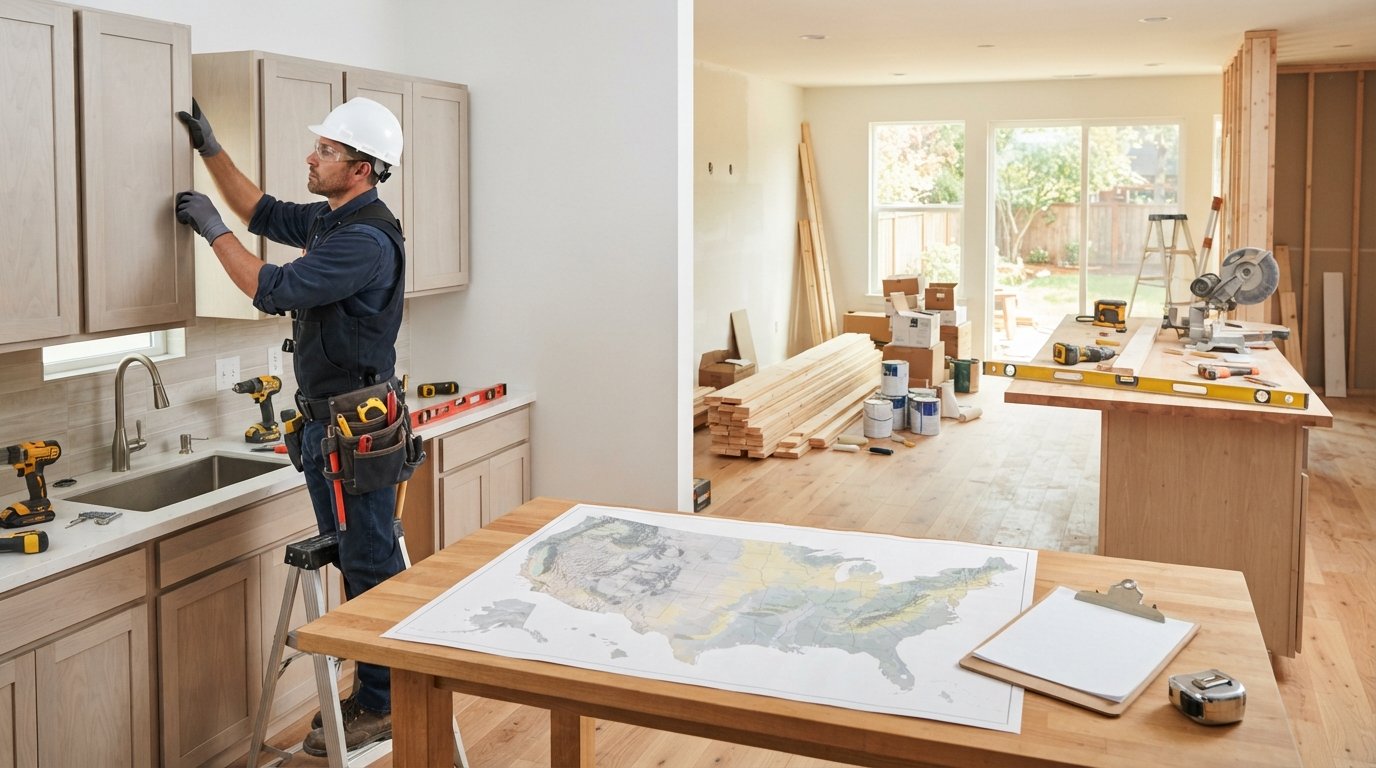
Home Renovation Cost per Square Foot by US Region
See home renovation cost per square foot by US region and compare realistic ranges before you budget. Call (833)-211-1668 for trusted local quotes.

By Olivia Owens
Learn more about Home Remodeling for guides, costs, and what to expect.
Compare Home Remodeling Pros Near You

Enter your ZIP code to compare top-rated local professionals and request free quotes.
Planning a renovation feels a lot like planning a cross-country road trip: the destination may be the same, but the cost of getting there changes dramatically depending on where you start. A kitchen remodel in rural Ohio can cost tens of thousands less than a similar project in San Francisco, and the gap is not just about fancy finishes. Labor rates, permit fees, material shipping distances, and local demand all push the price per square foot up or down as you move across the country. Understanding these regional differences is the first step toward building a renovation budget that will not collapse the moment a contractor hands you an estimate.
In this guide, we break down home renovation cost per square foot by US region, with practical ranges for kitchens, bathrooms, and whole-home projects. You will see why the Northeast and West Coast command premium prices, how the Midwest and South keep costs comparatively low, and what to do with this information once you have it. The goal is not to memorize a single national average (which is almost always misleading) but to learn how to read regional benchmarks and use them to pressure-test the bids you receive.
Why Renovation Costs Vary So Much by State and Metro Area
The single biggest driver of regional cost variation is labor. Construction labor is local by nature: crews live near the job site, and their wages reflect the local cost of living. A carpenter in New York City earns a wage that would be unusual in Alabama, and that difference flows directly into every line item on your estimate. According to national construction cost data, labor can account for 40 to 60 percent of a renovation budget, so even a modest wage gap compounds quickly across a whole-house project.
Permits and regulatory overhead add another layer. Coastal cities and older metro areas often have complex zoning, historic preservation rules, and slow inspection timelines that increase both direct fees and the indirect cost of delays. Material logistics matter too: dense urban markets may have cheaper materials because suppliers compete fiercely, but they charge more for delivery and staging because streets are narrow and parking is scarce. In remote areas, the opposite is true: materials cost more to ship, but labor and land are cheaper.
Local demand swings costs as well. In fast-growing metros like Austin, Denver, or Miami, contractor availability tightens during building booms, and prices rise accordingly. In slower markets, contractors may bid more aggressively to keep crews busy. This is why a cost benchmark for "the South" can hide huge differences between, say, Atlanta and a small town in Mississippi. When you evaluate estimates, always ask whether the contractor is pricing for the metro market or the surrounding region, because the two can differ by 20 percent or more.
Regional Cost Ranges for Kitchens, Bathrooms, and Whole-Home Renovations
To make regional comparisons useful, it helps to look at three common project types: a mid-range kitchen remodel, a mid-range bathroom remodel, and a whole-home renovation. The ranges below reflect typical mid-grade finishes (stock cabinets, quartz or laminate counters, standard fixtures) and standard layouts without structural changes. Luxury finishes, layout changes, and structural work can push costs well beyond these bands in every region.
Northeast (New York, Boston, Philadelphia, and surrounding metros): This is the most expensive region overall. Kitchen remodels commonly run $150 to $250 per square foot, bathrooms $200 to $350 per square foot, and whole-home renovations $200 to $400 per square foot. Historic housing stock, strict permitting, and high labor rates all contribute. In Manhattan and parts of Boston, upper-end figures can exceed these ranges significantly.
West Coast (California, Oregon, Washington): Costs here are close to the Northeast and sometimes higher in tech-heavy metros. Expect $140 to $250 per square foot for kitchens, $180 to $320 for bathrooms, and $180 to $350 for whole-home work. Labor shortages, seismic retrofitting requirements, and expensive permitting in cities like San Francisco and Seattle drive the upper end. Rural parts of these states are notably cheaper, sometimes 30 to 40 percent below metro rates.
Midwest (Ohio, Michigan, Illinois, Indiana, Missouri, and neighbors): The Midwest offers some of the most favorable pricing in the country. Kitchens typically fall between $80 and $150 per square foot, bathrooms $100 to $200, and whole-home renovations $100 to $200. Chicago is the outlier, with costs closer to coastal levels in the city core, while smaller cities and rural areas sit at the low end. Contractor availability is generally good, which keeps bidding competitive.
South (Texas, Florida, Georgia, Tennessee, the Carolinas, and nearby states): Southern costs vary widely by metro. Kitchens run $90 to $170 per square foot, bathrooms $110 to $220, and whole-home renovations $110 to $230. Fast-growing metros like Austin, Nashville, and Miami push toward the top of these ranges, while smaller towns remain affordable. Hurricane zones in Florida and the Gulf Coast add insurance and wind-load requirements that can raise structural costs.
Mountain and Plains states (Colorado, Utah, Arizona, Montana, the Dakotas): This is a mixed region. Denver and Phoenix metros are moderately expensive, with kitchens at $110 to $190 per square foot and whole-home work at $130 to $250. Rural mountain communities can be surprisingly costly because of shipping distances and limited contractor pools, sometimes rivaling coastal prices for remote builds.
These figures are starting points, not quotes. A useful exercise is to take the midpoint of your region's range and multiply it by your project square footage, then compare that number to the bids you receive. If a bid comes in 40 percent below the regional midpoint, ask what is being excluded. If it comes in 40 percent above, ask what premium features or site conditions justify the difference.
How Labor Rates, Permits, and Material Logistics Affect Your Total
Labor is where regional differences hit hardest, so it deserves a closer look. Skilled trades charge hourly rates that track local living costs: an electrician may bill $60 per hour in a midwestern city and $120 per hour in a coastal metro for the same work. Because renovations are labor-intensive, those hourly gaps multiply across framing, plumbing, electrical, drywall, and finish work. When you compare estimates from different regions, normalize by asking for labor hours and rates, not just lump sums.
Permits are the second hidden variable. A simple bathroom remodel might require a plumbing permit and an electrical permit in one city and a single combined permit in another. Fees can range from under $100 to several thousand dollars for larger projects, and inspection timelines can add weeks. Those weeks cost money: contractors factor in overhead for project management, and delays can push you into a higher-priced scheduling window. Always ask whether permit fees are included in the bid and who is responsible for pulling them.
Material logistics round out the picture. Bulky items like cabinets, countertops, and windows are expensive to ship and handle. In dense cities, delivery windows, elevator reservations, and limited staging space add handling fees. In remote areas, freight surcharges apply. A practical way to see the full effect is to build a simple comparison table for your project: list labor, permits, materials, and logistics as separate lines, then fill in regional benchmarks for each. This makes it obvious where your local market is expensive and where it is competitive.
If you want a structured way to turn these benchmarks into a working budget, a home renovation budget planner can help you map costs by category before you request quotes. Pairing that structure with regional per-square-foot ranges gives you a realistic target instead of a guess.
Using Regional Benchmarks to Evaluate Contractor Estimates
Regional benchmarks are most valuable when you use them as a filter, not a verdict. The workflow below turns a stack of bids into a clear decision. First, identify your region and metro type (urban core, suburb, or rural), then pull the matching per-square-foot range for your project type. Next, calculate the implied cost for your square footage and compare each bid against that range. Finally, investigate outliers by asking for line-item breakdowns. A bid that is far below the range often signals missing scope, unlicensed labor, or change-order surprises later; a bid far above it should come with a clear explanation of premium materials or difficult site conditions.
Here is a simple sequence you can follow when the estimates arrive:
- Confirm each bid covers the same scope: demolition, permits, materials, labor, cleanup, and disposal.
- Divide the total by your project square footage to get a per-square-foot number.
- Compare that number to the regional range for your project type and metro.
- Ask outliers for a line-item breakdown and written clarification of exclusions.
- Check licensing, insurance, and references before discussing price further.
This process protects you from the most common budgeting mistake: choosing the lowest bid without understanding what it excludes. It also gives you leverage in negotiation. If a contractor knows you have benchmarked the regional market, they are more likely to explain their pricing honestly rather than pad the estimate. For a deeper walkthrough of comparing bids line by line, see our guide on how to compare contractor estimates without overpaying.
When you are ready to gather real numbers, request multiple quotes from vetted local professionals so you can compare apples to apples. Platforms like Contractor.Homes connect homeowners with pre-vetted contractors and free quote requests, which makes it easier to collect several bids in your region and test them against the benchmarks above. The more bids you compare, the clearer your local market price becomes.
Frequently Asked Questions About Regional Renovation Costs
Is the national average cost per square foot useful? Only as a rough sanity check. National averages blend expensive coastal metros with affordable rural markets, so they rarely match any single homeowner's reality. Regional and metro-level ranges are far more reliable for budgeting.
Why is my quote higher than the regional range? Common reasons include structural work, layout changes, premium finishes, historic preservation requirements, difficult access, or urgent timelines. Ask for a line-item breakdown to see which factor is driving the difference.
Can I save money by buying materials myself? Sometimes, but contractors often get trade discounts you cannot access, and self-purchased materials can complicate warranty and scheduling. Discuss the approach with your contractor before deciding.
How often should I re-benchmark my budget? Recheck regional ranges at the start of planning and again when you receive bids. Material prices and labor rates shift, especially during busy building seasons.
Renovation costs will always vary by region, but the variation is predictable once you know what drives it. Use per-square-foot ranges as your starting compass, compare bids against them with a critical eye, and insist on clear scope and line-item detail. With those habits in place, regional cost differences become a planning advantage rather than a source of surprise.