
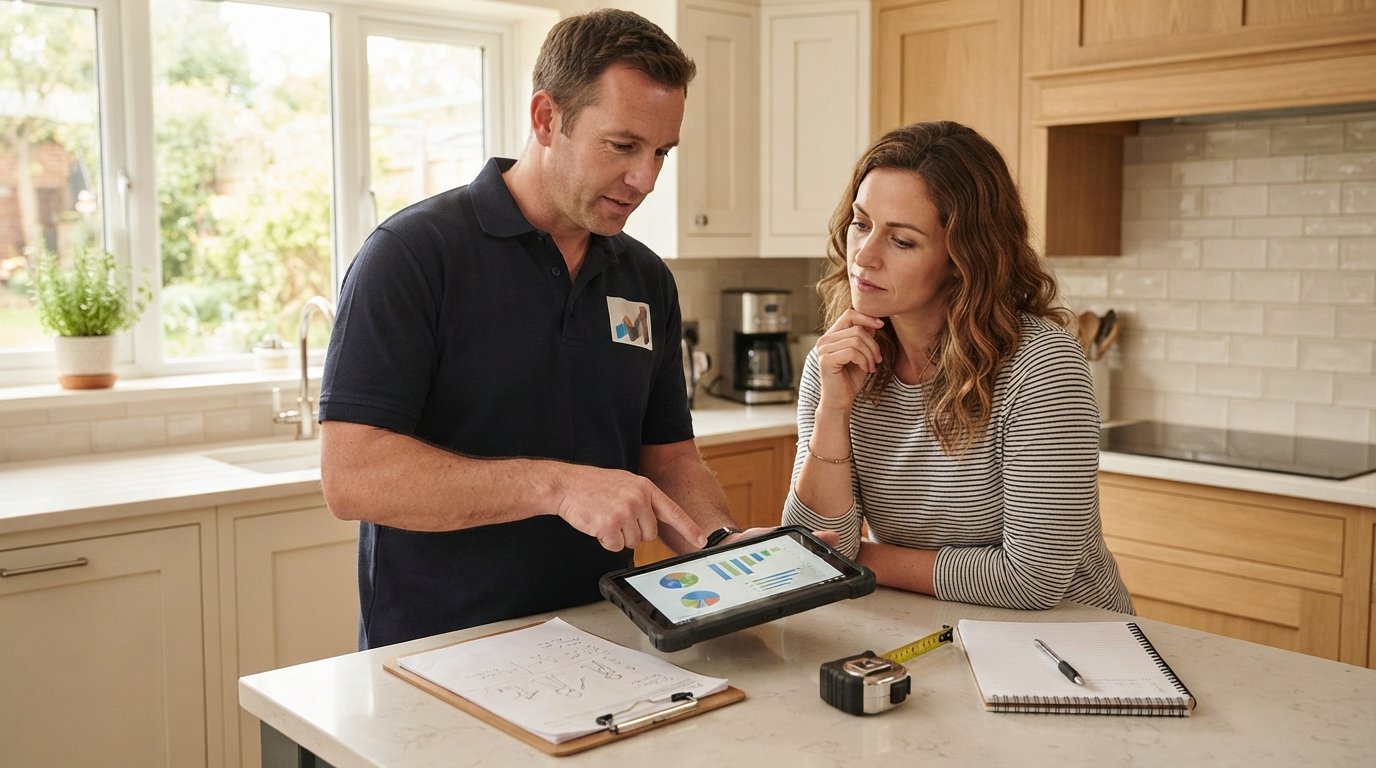
Home Repair Cost Estimator Accuracy vs Contractor Bids
Bridge the gap between online estimates and real bids. Call (833)-211-1668 to compare home repair cost estimator accuracy and contractor estimates today.

By Jack Dawson
Learn more about Home Inspection for guides, costs, and what to expect.
Compare Home Inspection Pros Near You

Enter your ZIP code to compare top-rated local professionals and request free quotes.
You have probably done it: typed your zip code, selected a repair type, and watched an online tool spit out a number that felt either shockingly high or suspiciously low. Then the first contractor walks through your door and quotes something entirely different. That gap between a digital estimate and a real bid is not a glitch. It is the predictable result of how estimators are built, what local contractors know about your specific home, and the assumptions baked into every calculation. Understanding home repair cost estimator accuracy and contractor estimates is the fastest way to stop guessing and start budgeting with confidence.
This guide breaks down why online calculators diverge from local bids, which inputs drive the biggest regional swings, and how to use rough estimators as a planning tool before you ever pick up the phone. You will also learn the exact questions that turn a ballpark figure into a firm, signed proposal. By the end, you will know when to trust the algorithm and when to trust the professional standing in your kitchen.
Why Online Calculators and Local Bids Rarely Match
Online estimators are built on national averages and regional multipliers. They pull from public cost data, aggregated contractor surveys, and historical project records, then adjust for zip code using a cost-of-living index. That sounds rigorous, but the result is a statistical midpoint, not a prediction about your house. A calculator might tell you a bathroom remodel runs $18,000 in your area, but that figure assumes mid-grade materials, standard layout, no plumbing relocation, and a contractor who works at average local rates. Your bathroom might have cast iron pipes, a load-bearing wall, and a homeowner who wants imported tile. The estimate did not stand a chance.
Contractor estimates work from the opposite direction. A local professional looks at your actual conditions: the age of the wiring, the slope of the yard, the condition of the subfloor, and the permitting office's current backlog. They know which suppliers have material in stock and which subcontractors show up on time. Their bid reflects real labor hours at real local wages, not a national average. When you compare a calculator output to a contractor bid, you are comparing a statistical guess to a site-specific projection. The gap is not a sign that one is wrong. It is a sign that they answer different questions.
This divergence is why homeowners who rely solely on online tools often experience budget shock. The estimator gave them a comfortable number, so they set their budget there. Then three contractors quote 30 to 50 percent higher because the tool never asked about asbestos abatement, a required electrical panel upgrade, or the fact that local permit fees doubled last year. The tool was not lying. It was simplifying. A contractor estimate is a commitment to do specific work for a specific price under specific conditions. That specificity costs money, and it is worth every penny when the drywall comes down and surprises appear.
The Inputs That Drive Estimate Variance by Region
Not all estimate gaps are created equal. Some inputs swing wildly from one market to the next, and those are the ones that make a national calculator almost useless without local calibration. Labor rates are the biggest culprit. A journeyman plumber in San Francisco earns a very different hourly rate than one in Dallas, and that difference flows directly into every repair bid. Material costs also vary by region due to shipping distances, local supplier competition, and climate-specific requirements. A roofing estimate in hurricane country includes different fasteners and underlayment than one in the desert Southwest.
Permit costs and inspection timelines add another layer of regional variance that calculators rarely capture well. Some municipalities charge flat fees, others charge by project valuation, and a few require expensive engineering letters for seemingly simple repairs. A contractor who pulls permits every week knows exactly what the local office will demand. An online estimator might include a generic permit allowance that is either too high or dangerously low. Climate and code also interact: freeze-thaw cycles, seismic zones, and wildfire codes all change the materials and methods required, which changes the price.
Here are the inputs that most reliably cause an online estimate to miss the mark in a specific region:
- Local labor rates and crew availability: Tight labor markets push bids higher than national averages, especially for skilled trades like electrical and plumbing.
- Permit fees and inspection requirements: Some cities require multiple inspections or special approvals that add both cost and time.
- Material logistics and climate specs: Coastal, desert, and cold-climate homes need different materials that cost more and may have longer lead times.
- Age and condition of the home: Older homes often hide code-compliance upgrades that a generic calculator never asks about.
- Access and site conditions: A crawlspace repair in a tight urban lot costs more than the same repair with a wide driveway and easy access.
When you request quotes through a platform that connects you with pre-vetted local contractors, you are essentially outsourcing the regional calibration that online calculators cannot provide. For example, homeowners searching for a contractor estimate in Houston, Texas need to account for humidity-driven moisture issues and specific local code requirements that a national tool will never flag. The same repair in Phoenix or Chicago carries a different set of hidden variables. The more local the input, the more accurate the output.
How to Use Estimators for Budgeting Before Requesting Quotes
Online estimators are not useless. They are excellent for setting a preliminary budget range and for sanity-checking a contractor's bid. The key is to use them as a starting point, not a final answer. Treat the calculator output as a midpoint and build a range around it. A common rule of thumb is to add 15 to 25 percent for contingency on top of the estimator figure, then compare that adjusted range to the bids you receive. If a contractor comes in far below the range, ask what is excluded. If they come in far above, ask what site-specific conditions drove the number up. Either conversation makes you a smarter buyer.
Use estimators to prioritize projects as well. If you have three repairs on your list and a limited budget, a quick estimator pass can tell you which one is likely to consume the most capital. That helps you sequence projects logically, tackling safety and structural issues first while deferring cosmetic upgrades. Estimators are also useful for negotiating. When you have a rough sense of what a job should cost, you can push back on line items that seem inflated and ask for clarification on vague allowances. Knowledge is leverage, even when the knowledge is approximate.
One powerful approach is to run two or three different estimators for the same project and compare their outputs. If all three land within 10 percent of each other, you have a reasonably reliable range. If they diverge wildly, that is a signal that the project has high variability and you need real bids sooner rather than later. Bring those estimator printouts to your contractor conversations. A good contractor will appreciate that you have done homework and will explain where the tool was right and where it missed the mark. That explanation alone is often worth the time you spent clicking through the calculator.
For homeowners who want a streamlined way to move from online research to real numbers, a marketplace like Contractor.Homes can connect you with local professionals who provide free, competitive quotes. The transition from estimator to actual bid is where the real budgeting happens, and having multiple vetted contractors respond to the same scope gives you a built-in accuracy check.
Questions That Turn a Rough Estimate Into a Firm Bid
The moment a contractor hands you a number, your job is to convert that number from a rough estimate into a firm, binding bid. That conversion happens through questions. The first and most important question is simple: what is included and what is excluded? A bid that says "install tile" without specifying tile grade, grout type, and square footage is not a bid. It is a placeholder. Ask for a line-item breakdown that separates labor, materials, permits, disposal fees, and any subcontractor costs. The more granular the breakdown, the more accountable the contractor becomes.
Next, ask about site conditions and contingencies. What happens if the contractor opens a wall and finds water damage or outdated wiring? Is there a change-order process, and how are change-order prices determined? A firm bid should include a clear contingency clause that protects both parties. Ask whether the bid assumes a specific condition (for example, "subfloor is sound") and what the price adjustment would be if that assumption proves false. This is not about being distrustful. It is about aligning expectations before work begins, which is the single best way to avoid disputes later.
Here is a sequence of questions that reliably turns a rough estimate into a firm commitment:
- What exactly is included in this price? Request a written scope that lists materials, labor, permits, cleanup, and disposal.
- What assumptions could change the price? Ask for the specific site conditions the bid relies on and the cost of common contingencies.
- How do you handle change orders? Get the process in writing, including who approves changes and how pricing is set.
- What is the payment schedule? A firm bid should tie payments to milestones, not to a calendar.
- Who pulls the permits and schedules inspections? Confirm that the contractor handles this and that the cost is included.
After you ask these questions, ask for the bid in writing and compare it side by side with the other bids you received. The lowest number is not always the best value. A bid that is 10 percent higher but includes permits, disposal, and a clear contingency clause may actually save you money when the project hits an unexpected snag. The goal is not to find the cheapest number. It is to find the most complete and transparent number, then hold the contractor to it.
When to Trust the Algorithm and When to Trust the Pro
There is a time and place for each tool. Trust the online estimator when you are in the early planning phase, when you need a rough order of magnitude, or when you are comparing the relative cost of different project types. Trust the contractor when you are ready to commit money, because the contractor is the one who will actually perform the work and absorb the risk of site-specific surprises. The smartest homeowners use both: estimators to set expectations and screen bids, contractors to finalize scope and price.
It also helps to understand that home repair cost estimator accuracy improves as you feed it better inputs. If the tool asks for your zip code, home age, and project scope, answer carefully. Do not guess. If you know your home has galvanized pipes or a 60-amp electrical panel, note that in the comments if the tool allows it. The more honest your inputs, the closer the output will be to a real bid. But even with perfect inputs, an estimator cannot see your home. Only a contractor can do that.
Finally, remember that a contractor estimate is not just a number. It is a professional opinion backed by experience, local knowledge, and accountability. When you request free quotes from pre-vetted local contractors, you are buying access to that opinion without paying for it upfront. Use the estimator to prepare your questions, then use the quotes to make your decision. That combination gives you the best of both worlds: the speed of digital tools and the accuracy of local expertise.
Home repair budgeting does not have to be a guessing game. Start with an estimator to set a range, adjust for local variables, and then bring in contractors to turn that range into a firm plan. Ask the right questions, get everything in writing, and compare bids on completeness rather than price alone. When you do that, the gap between the online number and the real bid stops being a source of anxiety and becomes a source of confidence. You will know what you are paying for, why it costs what it costs, and how to protect your budget from the surprises that every home eventually delivers.